
Article by Alex Blau, DO – Associate Editor of the NAEMSP Blog and ChristianaCare Emergency Medicine; Associate Medical Director, LifeNet/CareNet Critical Care Transport
Edited by Michael DeFilippo, DO, FAAEM, Editor-in-Chief, NAEMSP Blog
Case
It’s a cold day in February and you arrive on the scene of an MVC to find a critically injured entrapped patient in a passenger vehicle that was pinned under a tractor trailer. The driver of the tractor trailer is being evaluated by another EMS clinician and appears stable. Your patient is a 22-year-old female, who is awake and alert, oriented x4, with a GCS of 15. She has a heart rate of 136, and a blood pressure of 90/60. She is complaining of bilateral lower extremity pain and right upper extremity pain. She feels very lightheaded and appears pale. You are able to access her face, upper chest, and left arm, but her right arm and legs are pinned by her crushed sedan cabin. The fire department is on scene and has started the extrication process. The Fire Chief informs you they have called in the technical rescue team and a rotating wrecker truck to lift the trailer off of her car. He predicts this will be a prolonged extrication.
The Lethal Triad
Most EMS clinicians and emergency physicians learn about the Lethal Triad during their training. We know that the combination of coagulopathy, acidosis, and hypothermia can lead to significantly worse outcomes in trauma.
Coagulopathy: Trauma causes major disruptions to the endothelium (the inner lining of blood vessels) which in turn leads to massive consumption of our clotting factors. This can further lead to dysregulated fibrinolysis, causing the paradoxical issue of patients who are actively bleeding, but also at high risk of forming clots.
Acidosis: Massive hemorrhage leads to hypovolemic shock and tissue hypoperfusion. This ends up creating a situation where the cells of the body rely on anaerobic metabolism and lactate production, creating an acidosis. The acidosis further impairs the coagulation factors in the body.
Hypothermia: Environmental exposure and massive blood loss, as well as decreased metabolic heat production, lead to impairment of normal physiologic functions including coagulation. Iatrogenic administration of cold fluids can further worsen hypothermia.
Management: We know that the mainstays of trauma treatment in these patients include early hemorrhage control, keeping the patient warm, administration of TXA, and giving blood products. Early hemorrhage control may include placing a tourniquet, applying direct pressure to a wound, or in the case of major or internal bleeding, quick transport to a Trauma Center for management by a trauma surgeon. Many EMS agencies also have the ability to administer TXA to help manage the coagulopathy of trauma. TXA prevents the conversion of plasminogen to plasmin. Plasmin is one of the factors responsible for breaking down blood clots, so administration of TXA helps stabilize the clots the body is able to form. There has also been an uptick in the number of EMS agencies that are able to give prehospital whole blood. Whole blood helps keep tissue perfused, preventing acidosis, and contains a replenishment of the clotting factors being consumed by the traumatic injury. In many cases, the whole blood can be given via a blood warmer, which also addresses the hypothermia.
By managing all three aspects of the lethal triad, trauma patients are more likely to survive transport to the hospital, and have better outcomes once they arrive there.
The Lethal Diamond
It is generally well known that the administration of blood products can lead to hypocalcemia. Blood products contain citrate to help keep them shelf-stable. When blood is given to a patient, that citrate binds to the body’s calcium and can cause hypocalcemia.
It is important to understand why the blood bank adds citrate to blood products. Yes, it keeps them shelf-stable for longer. But how does it do this? Citrate acts as a preservative, stabilizing the membranes of the red blood cells, and preventing them from hemolyzing. Importantly, the citrate also binds to the calcium in the serum of the donated blood. Calcium is an important factor in the body’s clotting cascade and is necessary for the clotting cascade to function. By adding citrate to the donated blood, the blood bank is able to prevent the donor blood from clotting while it is in storage.
Herein lies the major problem for our trauma patients. When we give them blood products we are helping to prevent or reverse hypothermia, acidosis, and coagulopathy (the lethal triad). But we are also now causing a new problem, by inadvertently giving citrate, which binds to the calcium in our patient. With their calcium now bound to citrate, it cannot function as needed in the coagulation cascade. All trauma centers and many EMS agencies ameliorate this by giving calcium with blood products. Problem solved, right?
Not necessarily. While the citrate in blood products does cause hypocalcemia, it is not the ONLY cause of hypocalcemia in trauma. There is a growing body of evidence that trauma patients can have hypocalcemia REGARDLESS of whether they received blood products. One study (Vivien et al. 2005) showed that 64% of trauma patients admitted to a hospital had mild to moderate hypocalcemia, even though they did not receive blood products. 10% of patients had severe hypocalcemia. A military study (Conner et al. 2021) showed that 54% of military traumatic injuries in combat were associated with hypocalcemia even though they had not received blood products on presentation to a forward surgical hospital.
What exactly is going on here?
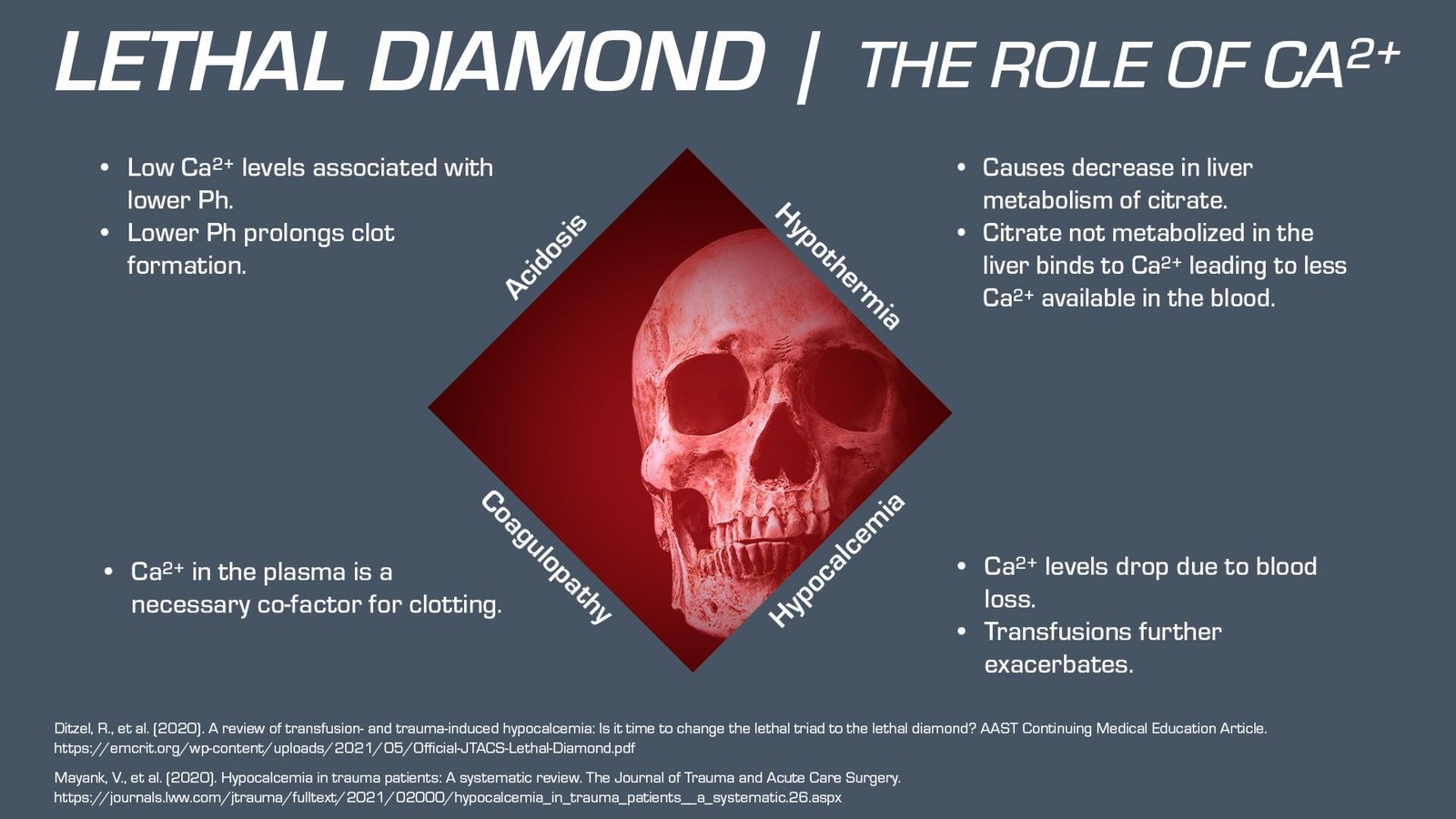
Much like the three elements of the lethal triad affect each other, they also affect calcium consumption.
Coagulopathy: As our body consumes its clotting factors, the calcium necessary to promote the clotting cascade is also consumed.
Acidosis: Lower calcium levels are associated with acidosis.
Hypothermia: Low core body temperature affects the metabolic functions of the cells and impairs calcium transport. Additionally, hypothermia plays a role in the liver’s metabolism of citrate, meaning that in patients who do receive a blood transfusion, hypothermia worsens their hypocalcemia even further by prolonging the time the citrate is in the blood.
Hypocalcemia: As noted above, coagulopathy and consumption of clotting factors lead to decreased calcium, worsening the cycle of coagulopathy. Hemorrhage also leads to hypocalcemia. As already noted, the citrate in any administered blood products worsens hypocalcemia.
With the importance of calcium, and its interplay with coagulopathy, acidosis, and hypothermia, there has been a move towards redefining the Lethal Triad as the Lethal Diamond (Ditzel et al. 2020).
Back to the Case
The extrication takes over 2 hours. The patient’s blood pressure continues to drop, and she ends up receiving 3 units of blood in the field. She is also given TXA and 1 gram of calcium. Warming is attempted with forced warm air and warming blankets placed over her chest. Upon extrication she is found to have a large open laceration to her left thigh with active bleeding. A tourniquet is placed and bleeding is controlled. She is transported to the hospital, where she is found to have multiple fractures, acute blood loss anemia, hypothermia, and a pulmonary embolism in her right main pulmonary artery. She was discharged from the hospital to rehab 2 weeks later, and discharged home 3 weeks after that.
Given the prolonged extrication time and inability to achieve hemorrhage control over the area of bleeding due to the entrapment, the administration of blood products was very likely crucial in her survival. The team on scene managed all aspects of the lethal diamond in this case, and importantly gave 1 gram of calcium as soon as the decision was made to give her blood.
Recognizing the importance of calcium in the pathophysiology of trauma, many researchers have begun to further explore its use. In April 2026 Rajesh et al. reviewed 273 trauma patients who received low-titer O whole blood and found that calcium chloride given at 1 gram or more per 2 units of blood was independently associated with an 84% reduction in 24-hour mortality; calcium gluconate showed no such association in the same cohort. The CAVALIER trial (Calcium and Vasopressin following Injury Early Resuscitation) is a currently ongoing double-blinded, multicenter, prehospital and early in-hospital randomized trial that will further explore the use of empiric calcium in the prehospital environment. (Learn more about the CAVALIER trial here: https://www.litesnetwork.org/cavalier/)
Although calcium clearly plays a very important role in management of trauma patients, it is not yet fully clear in the scientific literature how important the administration of calcium is in actual trauma outcomes for patients that do not receive blood products. With the ongoing active research we will hopefully have more data soon to guide our therapy. However, there is clearly a signal in the early data, and we should continue to monitor this research for major practice changes. There may be a day when even agencies that do not have the ability to give blood will give calcium.
References
- North American Rescue. Lethal Diamond. NAR Blog, 2023. https://www.narescue.com/nar-blog/lethal-diamond.html
- Vivien B, Langeron O, Morell E, Devilliers C, Carli PA, Coriat P, Riou B. Early hypocalcemia in severe trauma. Crit Care Med. 2005 Sep;33(9):1946-52. doi: 10.1097/01.ccm.0000171840.01892.36. PMID: 16148464.
- Conner JR, Benavides LC, Shackelford SA, Gurney JM, Burke EF, Remley MA, Ditzel RM, Cap AP. Hypocalcemia in Military Casualties From Point of Injury to Surgical Teams in Afghanistan. Mil Med. 2021 Jan 25;186(Suppl 1):300-304. doi: 10.1093/milmed/usaa267. PMID: 33499442.
- Ditzel RM Jr, Anderson JL, Eisenhart WJ, Rankin CJ, DeFeo DR, Oak S, Siegler J. A review of transfusion- and trauma-induced hypocalcemia: Is it time to change the lethal triad to the lethal diamond? J Trauma Acute Care Surg. 2020 Mar;88(3):434-439. doi: 10.1097/TA.0000000000002570. PMID: 31876689.
- Vasudeva M, Mathew JK, Groombridge C, Tee JW, Johnny CS, Maini A, Fitzgerald MC. Hypocalcemia in trauma patients: A systematic review. J Trauma Acute Care Surg. 2021 Feb 1;90(2):396-402. doi: 10.1097/TA.0000000000003027. PMID: 33196630.
- Rajesh A, Barry L, Limon D, Patel P, Epley S, Hargrove K, Giddings D, Tobin J, Eastridge B, Nicholson S, Jenkins D. Aggressive calcium chloride dosing reduces early mortality in trauma patients receiving whole blood resuscitation. J Trauma Acute Care Surg. 2026 Jul 1;101(1):57-64. doi: 10.1097/TA.0000000000005009. PMID: 41995161.