Author: Michael DeFilippo, DO Assistant Professor of EM and EMS – Washington University at St. Louis School of Medicine
Editors: Aaron Lacy, MD Assistant Professor of EM – Washington University at St. Louis School of Medicine; Sarah E. Fabiano, MD, FACEP, FAAEM, FAEMS Clinical Associate Professor, Department of Emergency Medicine, Prisma Health–Upstate University of South Carolina School of Medicine Greenville
Background
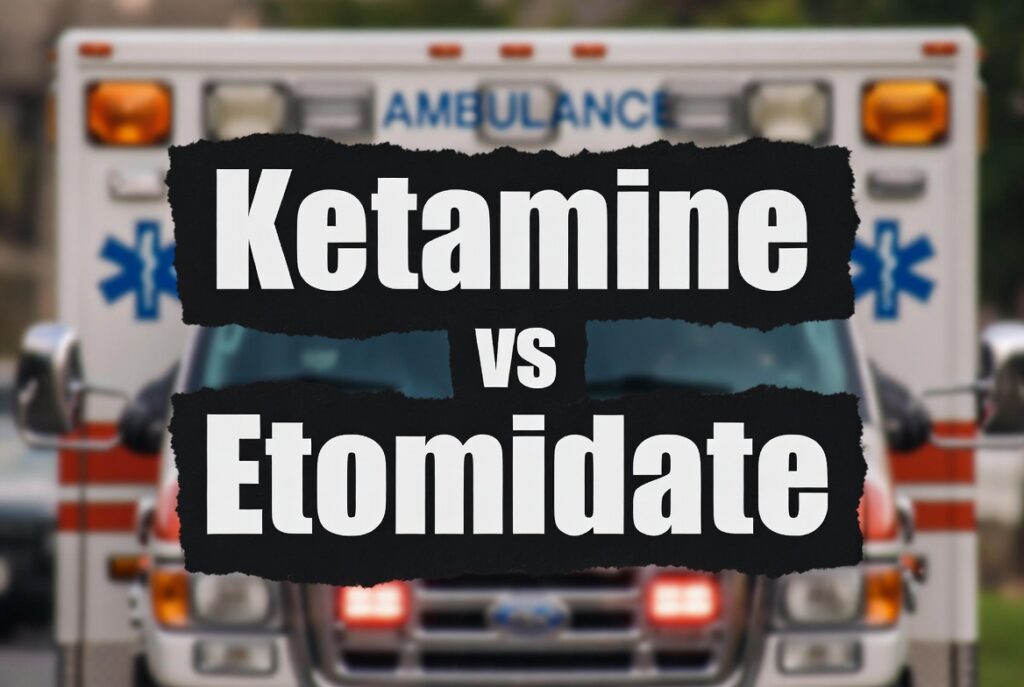
For years, ketamine has been widely embraced in EMS as the “hemodynamically safe” induction agent. Many of us learned it as the go-to medication for the borderline hypotensive patient; something that supports catecholamines, preserves blood pressure, and keeps people stable during one of the most physiologically stressful procedures we perform.
A new multicenter trial, The RSI Trial, challenges that assumption. The results do not argue against ketamine; instead, they give us a clearer and more realistic picture of how ketamine behaves in the sickest patients we intubate. In short: ketamine is still an excellent RSI medication, but it is not as blood pressure neutral as we once believed.
Let’s take a look at what the data actually show and how it translates to EMS practice.
The Trial in Brief
Investigators enrolled 2365 critically ill adults undergoing ED or ICU intubation. Patients were randomized to receive either ketamine or etomidate as the induction agent. About half of the patients had sepsis or septic shock, and roughly one fifth were already on vasopressors before intubation. Patients were excluded if they were trauma cases, in cardiac arrest at the time of intubation, undergoing intubation without paralytics, or already deeply sedated.
Mortality at 28 days was essentially identical between groups: Ketamine: 28.1% versus Etomidate: 29.1%. Even among the large subgroup with sepsis and septic shock, mortality remained nearly the same (Ketamine 38.8% versus Etomidate 38.2%).
The short peri-intubation period, however, told a different story.
Researchers tracked a composite called cardiovascular collapse from induction to two minutes after tube placement. This included systolic pressure less than 65 mmHg, the need for new or higher vasopressors, or cardiac arrest.
Cardiovascular collapse occurred more often with ketamine (22.1%) versus with etomidate (17.0%). This difference was driven largely by more pronounced blood pressure drops in the ketamine group. Patients receiving ketamine had lower nadir systolic pressures, more episodes of systolic pressure below 80 mmHg, more 30 mmHg declines in systolic pressure, higher rates of vasopressor escalation, and more ventricular tachycardia.
The effect was most pronounced in the sickest patients, particularly those with septic shock and very high APACHE II scores::
- Sepsis and Septic Shock
- Ketamine: 30.6%
- Etomidate: 20.9%
- Absolute difference: 9.7 percentage points
- APACHE II ≥ 20
- Ketamine: 31.4%
- Etomidate: 20.7%
- Absolute difference: 10.7 percentage points
This does not mean ketamine is unsafe; rather, it means ketamine produces more acute hemodynamic instability than many of us expected, especially when patients are already catecholamine-depleted. These short-term hemodynamic swings matter because induction is one of the most vulnerable two-minute windows in critical illness, and small perturbations can precipitate downstream deterioration.
Despite the higher rate of early hemodynamic events with ketamine, there were no meaningful differences between groups in first-pass success, hypoxemia, ICU-free days, ventilator-free days, or vasopressor-free days. In other words, the additional peri-intubation hypotension associated with ketamine did not translate into worse long-term organ support needs or mortality.
Understanding the Nuance Behind the Numbers
The trial was large and open-label, and the cardiovascular collapse outcome includes elements that could theoretically be influenced by clinician behavior. For example, if a clinician expected ketamine to drop blood pressure, they might have escalated pressors earlier in the intubation preparation phase. However, this concern should be kept in perspective. Fewer than 1% of patients (14 of ~2400) did not receive their assigned induction agent, suggesting that true randomization was largely preserved. In addition, supplemental analyses showed no significant differences between groups in vasopressor use prior to intubation, within one hour of intubation, or in prophylactic vasopressor administration. Taken together, while open-label design introduces some nuance, it is unlikely that clinician behavior meaningfully biased the hemodynamic findings.
What the study did show was a 1% higher mortality with etomidate (29.1% vs 28.1%). The challenge is that a difference this small cannot be meaningfully interpreted by a trial of this size. The authors performed extensive sensitivity analyses, and in a high-quality, multicenter trial with careful patient matching and standardized, weight-based dosing, caution is warranted when interpreting non-statistically significant differences. In critical care, even a 1% change in mortality could matter, but detecting or disproving a signal that subtle would require an enormous study that is unlikely ever to be done. As a result, while mortality appears similar overall, the trial cannot definitively exclude a small but clinically meaningful difference between agents. For additional context and a deeper dive into the trial’s methodology and interpretation, Dr. Farkas’ PulmCrit blog post is a worthwhile read.
The most important message for EMS clinicians is not that one drug is right and the other is wrong. It is that ketamine is not the “BP safe” drug many of us believed it to be. It is excellent; but it is not magical.
Clinical Implications for EMS RSI
Etomidate may offer more predictable hemodynamics in the following situations:
- Profound septic shock
- High vasopressor requirement or clear catecholamine exhaustion
- Cardiogenic shock or severe pump failure
- Known ventricular arrhythmia risk
- Significant RV failure or pulmonary hypertension
In these scenarios, the combination of ketamine’s negative inotropy under catecholamine-depleted conditions and the small but notable increase in ventricular tachycardia observed in the trial should give pause.
That being said, ketamine is still the preferred medication in many EMS scenarios:
- Severe asthma or COPD where preservation of respiratory drive prior to apnea is essential
- Status epilepticus
- Patients with major pain or polytrauma where analgesia plus sedation is ideal
- Delayed sequence intubation when maintaining respiratory drive is important
- Most “routine” medical intubations that involve mild or moderate shock but not profound circulatory collapse
Preparation Matters Most
The most important adjustment for EMS RSI is not the choice of drug; it is the preparation around intubation. The trial does not argue against ketamine; it simply corrects our overconfidence. Prepare for a possible drop in blood pressure and treat ketamine like any other induction agent that can expose underlying instability. Regardless of whether ketamine or etomidate is used:
- Resuscitate before you intubate
- Have push-dose pressors drawn and ready
- Start or escalate vasopressors early when indicated
- Minimize peri-intubation pauses and optimize oxygenation
- Recognize fragile physiology early and support it proactively
Ketamine remains a powerful and versatile tool in the EMS airway kit; it simply requires the same respect we give all induction agents. The RSI trial reminds us that airway management is fundamentally a physiologic event, not just a technical one. Drug selection is important, but the real determinants of safety are preparation, resuscitation, and anticipation of instability. When EMS clinicians approach RSI with that mindset, both ketamine and etomidate can be used safely and effectively in the field. It is also worth noting that ketamine may offer additional benefits beyond hemodynamics; emerging data suggest it may reduce patient awareness during paralysis and potentially mitigate post-intubation psychological distress, although these findings remain inconclusive and are the subject of ongoing investigation.
Key Takeaways
- Ketamine and etomidate have similar mortality outcomes for critically ill patients.
- Ketamine causes more peri-intubation hypotension, pressor escalation, and ventricular tachycardia.
- These effects are strongest in septic shock and very high-acuity patients.
- Etomidate may be preferable in profound septic shock, cardiogenic shock, or significant ventricular dysfunction.
- Ketamine remains excellent for preserving respiratory drive during sedation, seizures, agitated hypoxia, trauma, and moderate illness.
- The most important determinant of safe RSI is not the drug; it is preparation, resuscitation, and hemodynamic readiness.