
jli0814

Trouble in Thin Air: Responding to Inflight Medical Emergencies

By Mark Liao, MD, NRP (@EMSFellowMark) Peer Reviewed by Jeremiah Escajeda, MD (@JerEscajeda) Clinical Scenario: As you settle into your seat on a cross-country airline flight to yet another Emergency Medicine conference, you hear the familiar Hi-Low tone signaling an announcement. Suddenly a pressured, yet professional, voice booms overhead: “If there is a medical professional …

Trouble in Thin Air: Responding to Inflight Medical Emergencies Read More »
Article Bites #11: Measuring the Impact of a Telehealth Program on Ambulance Transports

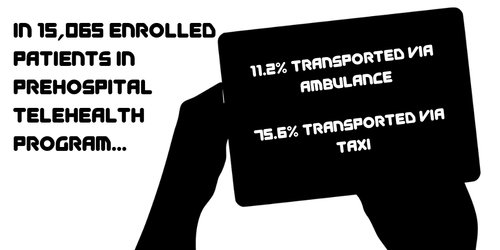
Article Reviewed: Champagne-langabeer T, Langabeer JR, Roberts KE, et al. Telehealth Impact on Primary Care Related Ambulance Transports. Prehosp Emerg Care. 2019;:1-6. [PMID: 30626250] Background & Objectives: Prior studies have confirmed what is known by many of those who work in EMS: a high proportion of patients that are transported have non-emergent conditions. Several studies have …

Article Bites #11: Measuring the Impact of a Telehealth Program on Ambulance Transports Read More »

Can ET3 push the field of medical direction to where it should be?

by Melissa Kroll, MD and Hawnwan P. Moy, MD  Introduction The Center for Medicare and Medicaid Services’ (CMS) passage of the Emergency Triage, Treat, and Transport model (ET3) not only recognizes EMS as part of the health care system but is a significant step in developing a mature EMS system.  But what does this mean …

Can ET3 push the field of medical direction to where it should be? Read More »

Article Bites #10: Delivering Right Care and Transporting to the Right Place: Medical clearance of Psychiatric Emergencies in the Field

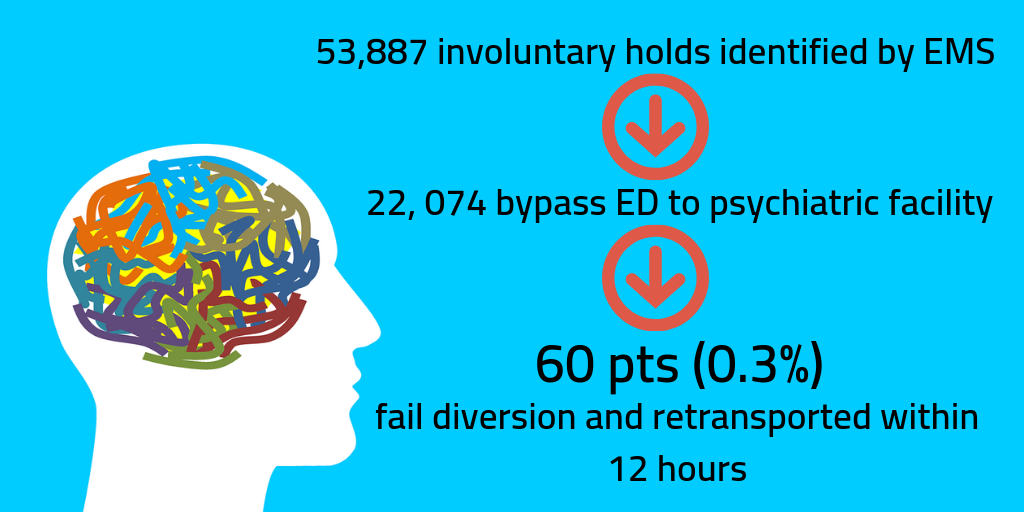
Article: Trivedi TK, Glenn M, Hern G, Schriger DL, Sporer KA. Emergency Medical Services Use Among Patients Receiving Involuntary Psychiatric Holds and the Safety of an Out-of-Hospital Screening Protocol to “Medically Clear” Psychiatric Emergencies in the Field, 2011 to 2016. Ann Emerg Med. 2019;73(1):42-51. Background & Objectives: Due to a nationwide shortage of inpatient psychiatric beds, …

Article Bites #10: Delivering Right Care and Transporting to the Right Place: Medical clearance of Psychiatric Emergencies in the Field Read More »

Article Bites #9: The Emergency within EMS – Risk of Suicide in EMS Compared to the General Public

Death by Suicide — The EMS Profession Compared to the General Public Vigil NH, Grant AR, Perez O, et al. Death by Suicide-The EMS Profession Compared to the General Public. Prehosp Emerg Care. 2018;:1-6.[PMID: 30136908]   Background & Objectives:  Suicide is a public health crisis with an estimate 45,000 individuals dying from suicide annually. Certain professions, …

Article Bites #9: The Emergency within EMS – Risk of Suicide in EMS Compared to the General Public Read More »

Article Bites #8: Reconsidering Priorities of care: epinephrine in out of hospital cardiac arrest

A Randomized Trial of Epinephrine in Out-of-Hospital Cardiac Arrest Perkins GD, Ji C, Deakin CD, et al. A Randomized Trial of Epinephrine in Out-of-Hospital Cardiac Arrest. N Engl J Med. 2018. [PMID: 30021076] Background & Objectives: Other than early CPR and defibrillation, there are few measures that have been shown to improve outcomes for out-of-hospital …

Article Bites #8: Reconsidering Priorities of care: epinephrine in out of hospital cardiac arrest Read More »

Article Bites #7: Should Air Medical Transport administer plasma to trauma patients at risk for hemorrhagic shock?

Prehospital Plasma during Air Medical Transport in Trauma Patients at Risk for Hemorrhagic Shock Sperry JL, Guyette FX, Brown JB, et al. Prehospital Plasma during Air Medical Transport in Trauma Patients at Risk for Hemorrhagic Shock. N Engl J Med. 2018;379(4):315-326. [PMID: 30044935] Background & Objectives: Hemorrhagic shock remains the most significant cause of mortality in …

Article Bites #7: Should Air Medical Transport administer plasma to trauma patients at risk for hemorrhagic shock? Read More »

Article Bites #6: Mac vs. Miller – A Retrospective review of Intubation Success

by Aaron Farney, MD  Citation Alter, S. M., Haim, E. D., Sullivan, A. H., & Clayton, L. M. (2018). Intubation of prehospital patients with curved laryngoscope blade is more successful than with straight blade. The American journal of emergency medicine.  Background/Rationale There are two direct laryngoscope blades available to EMS: the curved Macintosh and the straight …

Article Bites #6: Mac vs. Miller – A Retrospective review of Intubation Success Read More »

Not Your Typical Wake Up: A review of opioid related noncardiogenic pulmonary edema

by Aaron Farney MD  Clinical Scenario  You are called for a 25-year-old male, possible overdose, unknown if breathing.  On arrival, the patient is unresponsive on his bathroom floor.  Family reports they found him on the floor not breathing just prior to calling 911.  They had last seen him well 15 minutes prior.  He has a …

Not Your Typical Wake Up: A review of opioid related noncardiogenic pulmonary edema Read More »

Scroll to Top